Swamiji TV

Other links


Video details

Contentment makes you happy

The Mūlādhāra cakra contains a seven-trunked elephant, symbolizing prosperity and the seven bodily constituents. Devas and Asuras churned the ocean for nectar, but first produced a deadly poison. Śiva drank and contained the poison, saving the world. This greed for nectar mirrors modern greed for resources like oil, which creates poisons. The churning later yielded treasures like the wish-fulfilling cow and the seven-trunked elephant. Wealth alone does not bring happiness; it is like a leaking cup. Contentment makes all other wealth insignificant. The chakras are interconnected; sound originates from the navel and ascends. Sweet speech arises from a balanced system.

"When you possess the wealth of elephants, the wealth of eagles, and mines of jewels, and then the wealth of contentment arrives, all other wealth becomes like dust."

"Place one hand on your navel and the other on the top of your head. Say, 'I am happy,' and you will feel the vibration."

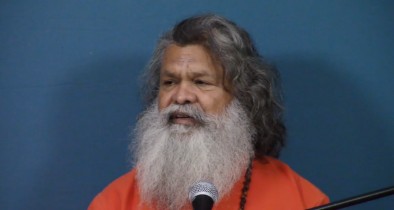
Filming location: Vancouver, Canada

The word 'gaja' means elephant. 'Gajānanda' means Gaṇeśa. In the Mūlādhāra cakra resides a gajānanda, an elephant with seven trunks. In the Satyuga, the devas and asuras churned the ocean to obtain the nectar of immortality, called amṛta. 'Amara' means everlasting, beyond birth and death. To churn the ocean, they used a great serpent, Vāsukināga, as a rope and Mount Meru as the churning rod. This was a conflict between the Devas, the gods, and the Asuras or Rākṣasas, over the kingdom of heaven, ruled by Indra. They were actually brothers, sons of one Ṛṣi who had thirteen wives, though their mothers were different. Both sides went to Śiva, the Lord who balances everything. While both devils and gods adore Śiva, he subtly supported the devas. The Asuras had a powerful guru, Śukrācārya, who was also a devotee of Śiva. Śiva, like a father managing a quarrelsome family, had to maintain equilibrium. He advised them that the ocean contained all wealth—jewels, diamonds, and the nectar—and told them to churn it. They coiled the serpent around the mountain. The Asuras, refusing to stand at the serpent's tail, held its head, while the Devas held its tail. As they began the immense task of churning, the first thing to emerge was not nectar, but a dark blue poison, hālahala. No one wanted it, fearing it would poison the world. Brahmā, Viṣṇu, and all the goddesses determined that only Śiva could solve this problem. Śiva was meditating in the Himalayas. His meditation lasts for ages, but for the sake of the world, he opened his eyes. They explained their predicament: the poison would destroy everything. When children create a problem, the responsibility falls upon the parents. Śiva said, "Okay, give it to me. I will drink it." They were happy and agreed without considering the consequence for him. Śiva drank all the poison. As he drank, he turned blue and is since known as Nīlakaṇṭha Mahādeva—'nīla' meaning blue, 'kaṇṭha' meaning throat. He held the poison in his Viśuddhi Cakra and neutralized it through the technique of Ujjāyī Prāṇāyāma, digesting it. Had it gone to his navel, even Śiva would have entered a deep sleep (yoga nidrā). The mountain where this happened is called Nīlakaṇṭha, near Alakapurī. At sunrise and sunset, the snow-covered peak reflects the sun's light, appearing like pure gold. This occurred because of the greed of the devas and asuras. Similarly, today, people are greedy for gold, money, and oil. They churn the oceans, like in the Gulf of Mexico, and what emerges? Oil, which spreads like a carpet, killing creatures and causing pollution—a modern poison. During that oil crisis, an Indian engineer suggested using guar gum (from the guar bean, gaur phalī) as a sealant. It worked perfectly. The demand made guar gum prices skyrocket, making farmers millionaires overnight. When the work finished, the demand vanished and the price collapsed, leaving those who had stockpiled it in ruin. This is the fruit of greed, like churning for nectar and getting poison. Similarly, creations like atomic bombs are poisons only a power like Śiva can control. After the poison, the churning yielded the celestial cow, Kāmadhenu, who fulfills all wishes (ichchhā pūrṇā). Once, a ṛṣi had to feed thousands of guests. Kāmadhenu produced endless food from her body to serve them all. The Asuras, not wanting the responsibility, gave her to the devas. Next emerged a beautiful white horse, Uccaiḥśravas, also given to the devas. Then came the seven-trunked white elephant, Airāvata, a symbol of prosperity, joy, and strength. The Asuras, again seeing no use for it, gave it away. This seven-trunked elephant in the Mūlādhāra cakra is also the seat of Gaṇeśa. The seven trunks represent the saptadhātu—the seven essential minerals or bodily constituents (like iron, calcium, potassium). For perfect health, we need all seven. By practicing Aśvinī Mudrā, we activate the glands to produce these dhātus. The elephant itself symbolizes prosperity. In ancient times, a rich person (gajadhana) owned thousands of elephants. Other forms of wealth are bhajadhana (wealth of golden hawks or eagles, kings among birds) and ratanadhana khāna (mines of precious stones and diamonds). Yet, with all this wealth, one may still not be happy. It is like a cup with a hole: the Guru may pour milk in from above, but it all leaks out. The Guru must first repair the cup. As the saying goes: Gajadhana, bhajadhana, aur ratanadhana khāna. Jab āyā santoshadhana, sab dhana dhūla samāna. "When you possess the wealth of elephants, the wealth of eagles, and mines of jewels, and then the wealth of contentment arrives, all other wealth becomes like dust." A yogī's aim is to achieve that state of peace, happiness, and joy, free from longing. Therefore, follow one master and one path. Trying many different sādhanās is like trying to weigh frogs on a scale: when one jumps, they all jump. A rich man may sleep peacefully hearing his wealth has increased, but a phone call about a fire in his warehouse can cause a heart attack. This is māyā—wealth, prosperity, desires. They are temporary, like dew (śubha pānī kā os) on grass that vanishes with the sunrise. Youth is fleeting. Do not be proud of youth, money, or strength. Everything changes. A proud, beautiful rooster loses his feathers after marriage, while the hen gains jewelry. That is māyā. Contentment is best. It brings peace and allows you to spread happiness. The seven-trunked elephant represents the saptadhātu and strength; it is Gaṇapati, whose seat is in the Mūlādhāra cakra. There is no "lower" chakra. I can change your chakra's position in half a minute—make the "lower" chakra the "upper" one by having you stand on your head (sirsāsana). The kuṇḍalinī energy connects them all. Maṇi means jewel, the jewel of immortality. Śiva is also present in the Mūlādhāra as the Śiva Liṅga. Brahmā, Viṣṇu, Śiva, and Gaṇeśa are all represented within this chakra system. The seat of sound is in the navel, the Maṇipūra cakra. Whenever you speak, pressure first comes on the navel. Place your hand there and say any word—"dog," "cat," "elephant," "chai," "coffee"—and you will feel the tension there. The Maṇipūra guides and coordinates our speech. For a child who cannot speak properly, specific āsanas can help perfect speech. The immortal amṛta churned from the ocean resides in the navel. It is created there, rises to the Viśuddhi cakra, is refined, goes to the brain, and then circulates through the body. Sound awakens from the navel. There are three levels of speech: parā (the origin or seed of sound in the navel), paśyantī (manifestation as sound at the vocal cords), and vaikharī (formation into words by the tongue and gums). The Upaniṣads say there should be honey on your tongue, meaning your words should be sweet, kind, humble, and peaceful, without harshness or bitterness. This quality arises from a balanced Maṇipūra cakra. When we meditate and chant "Aum," the vibration begins at the navel and ascends through the spinal column to the Sahasrāra cakra. They are connected like a single thread. Place one hand on your navel and the other on the top of your head. Say, "I am happy," and you will feel the vibration. This is not a miracle or trickery, unlike some who falsely claim to awaken your Kuṇḍalinī. There is a direct connection between the Mūlādhāra, Maṇipūra, and Ājñā cakras. There is a real story from a village. A dog barked all night, keeping everyone awake. One man decided to stop it. He took oiled cotton and applied it to the dog's anus, preventing it from contracting. When the dog tried to bark, the air pressure escaped the other way, and it could not produce a proper sound. This illustrates how the Maṇipūra, Mūlādhāra, and the systems of sound and pressure are interconnected and support one another. Oṁ Śāntiḥ Śāntiḥ.

This text is transcribed and grammar corrected by AI. If in doubt what was actually said in the recording, use the transcript to double click the desired cue. This will position the recording in most cases just before the sentence is uttered.

The text contains hyperlinks in bold to three authoritative books on yoga, written by humans, to clarify the context of the lecture:

Email Notifications

You are welcome to subscribe to the Swamiji.tv Live Webcast announcements.

Contact Us

If you have any comments or technical problems with swamiji.tv website, please send us an email.

Download App

YouTube Channel